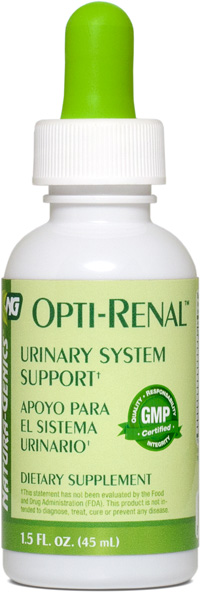
Opti-Renal™

1.5 FL. oz. •  45 mL.

Opti-Renal bottle
Opti-Renal bottle

The kidneys are two bean-shaped organs, each about the size of a fist. They are located below the rib cage, one on each side of the spine. Kidneys in good condition filter about half a cup of blood every minute, removing toxins and extra water to make urine. Urine flows from the kidneys to the bladder through the ureters (two thin tubes of muscle), one on each side of the bladder, which stores urine.

The kidneys, ureters, and bladder constitute the urinary system. The kidneys remove acid produced by cells in the body to maintain the correct balance of water, salts, vitamins, and minerals such as sodium, calcium, phosphorus, and potassium in the blood. Without this balance, nerves, muscles, and other tissues in the body may not work properly. The kidneys also make hormones that help control blood pressure, manufacture red blood cells, and keep bones strong, among many other functions.

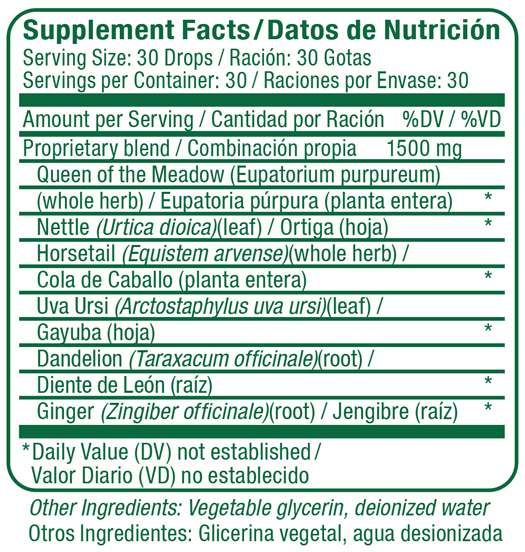
This supplement is a combination of six quality ingredients in liquid form, formulated to support the urinary system.

Indigenous to North America, queen of meadow (gravel root) is used as a therapeutic agent for the urinary-genital areas, affecting the kidneys, bladder, prostate gland, and uterus. Queen of meadow relaxes moderately, stimulates, and tones the pelvic viscera and mucous membranes.  This herb works well in combination with other herbs. It is also considered a powerful solvent of stony deposits in the kidneys. Queen of meadow is considered one of the most beneficial herbs for kidney and urinary problems.

Nettle is a leafy plant found in many temperate regions around the world and has long been valued for its therapeutic properties. It is naturally rich in chlorophyll and essential minerals, including iron, zinc, copper, magnesium, silicon, cobalt, and calcium. Nettle also contains several important vitamins, such as vitamins A, C, E, and K. Traditionally used for a variety of wellness applications, nettle is known to support the body’s natural inflammatory response by helping modulate cytokine activity. It also supports the body’s natural elimination processes by promoting the removal of excess fluids.

Horsetail has a long history of use in traditional herbal practices, particularly in parts of Europe and Asia. It has traditionally been used to support diuretic effects by promoting urine flow, which has contributed to its use in supporting urinary tract and overall kidney wellness. Ethnobotanical records and historical accounts also note its use for minor urinary discomfort and edema (fluid retention), reflecting its role in supporting healthy urinary function.

The leaves of uva ursi have long been valued for their medicinal properties. They were used by numerous indigenous people from northern latitudes. The glycoside arbutin is the main active constituent in uva ursi and comprises 10% of the plant by weight. Hydroquinone, derived from arbutin and methylarbutin, is considered a potent anti-bacterial agent, and it is thought to be responsible for uva ursi’s therapeutic effects on the urinary system.

Dandelion, a flower often considered a weed, is commonly used as food. The leaves are used in salads and teas, while the roots are used as a coffee substitute. Dandelion leaves and roots have been used for thousands of years for several conditions in the liver, gallbladder, and kidneys.  Dandelion has traditionally been used for water retention.

Research has shown that ginger may play a supportive role in kidney wellness by helping protect tissues from oxidative and environmental stressors, helping reduce damage or intoxication.

Supplement Facts

The kidneys are two bean-shaped organs, each about the size of a fist. They are located below the rib cage, one on each side of the spine. Kidneys in good condition filter about half a cup of blood every minute, removing toxins and extra water to make urine. Urine flows from the kidneys to the bladder through the ureters (two thin tubes of muscle), one on each side of the bladder, which stores urine.

The kidneys, ureters, and bladder constitute the urinary system. The kidneys remove acid produced by cells in the body to maintain the correct balance of water, salts, vitamins, and minerals such as sodium, calcium, phosphorus, and potassium in the blood. Without this balance, nerves, muscles, and other tissues in the body may not work properly. The kidneys also make hormones that help control blood pressure, manufacture red blood cells, and keep bones strong, among many other functions.

This supplement is a combination of six quality ingredients in liquid form, formulated to support the urinary system.

Indigenous to North America, queen of meadow (gravel root) is used as a therapeutic agent for the urinary-genital areas, affecting the kidneys, bladder, prostate gland, and uterus. Queen of meadow relaxes moderately, stimulates, and tones the pelvic viscera and mucous membranes.  This herb works well in combination with other herbs. It is also considered a powerful solvent of stony deposits in the kidneys. Queen of meadow is considered one of the most beneficial herbs for kidney and urinary problems.

Nettle is a leafy plant found in many temperate regions around the world and has long been valued for its therapeutic properties. It is naturally rich in chlorophyll and essential minerals, including iron, zinc, copper, magnesium, silicon, cobalt, and calcium. Nettle also contains several important vitamins, such as vitamins A, C, E, and K. Traditionally used for a variety of wellness applications, nettle is known to support the body’s natural inflammatory response by helping modulate cytokine activity. It also supports the body’s natural elimination processes by promoting the removal of excess fluids.

Horsetail has a long history of use in traditional herbal practices, particularly in parts of Europe and Asia. It has traditionally been used to support diuretic effects by promoting urine flow, which has contributed to its use in supporting urinary tract and overall kidney wellness. Ethnobotanical records and historical accounts also note its use for minor urinary discomfort and edema (fluid retention), reflecting its role in supporting healthy urinary function.

The leaves of uva ursi have long been valued for their medicinal properties. They were used by numerous indigenous people from northern latitudes. The glycoside arbutin is the main active constituent in uva ursi and comprises 10% of the plant by weight. Hydroquinone, derived from arbutin and methylarbutin, is considered a potent anti-bacterial agent, and it is thought to be responsible for uva ursi’s therapeutic effects on the urinary system.

Dandelion, a flower often considered a weed, is commonly used as food. The leaves are used in salads and teas, while the roots are used as a coffee substitute. Dandelion leaves and roots have been used for thousands of years for several conditions in the liver, gallbladder, and kidneys.  Dandelion has traditionally been used for water retention.

Research has shown that ginger may play a supportive role in kidney wellness by helping protect tissues from oxidative and environmental stressors, helping reduce damage or intoxication.