
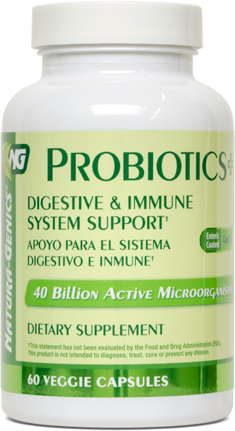
Probiotics+™
60 Veggie Capsules

Probiotics are microorganisms living within the body that positively contribute to the organism’s health. These friendly bacteria are also called intestinal flora.
There are estimated to be about 10 times as many bacteria in the body as cells, with most of them found in the gastrointestinal tract. This suggests that the human organism is largely microbial in nature. Some scientists suggest that the DNA of probiotic bacteria may be more important than human cells’ DNA in predicting vulnerabilities and possible future diseases.
Around one hundred trillion bacteria live in the digestive system, approximately 3.5 pounds worth. The digestive tract contains about 450 to 500 different bacterial species. About 20 species make up approximately 75 percent of the population, with many being resident strains attached to the intestinal walls.
The majority of probiotics live in the colon, and billions live in the mouth and small intestines. Other populations of bacteria and yeast can also live within joints, armpits, toenails, and the vagina.
Probiotics have been shown to support immune function, with friendly bacteria making up approximately 70 percent of the immune system. They may help rebuild cellular function, boost immune cell activity, and stimulate better immune responses. In addition, research has confirmed that probiotics may stimulate the effects of vaccines. Because probiotics help identify pathogens entering the organism, they can stimulate immune functions.
Science is still discovering the complex mechanisms and many benefits of the more than 500 species of still unresearched microorganisms that live in the body.
Probiotics+™ contains 40 billion active microorganisms to enhance and balance the intestinal microflora. This product promotes digestive function by relieving intestinal gas, bloating, and constipation. It also supports healthy immune function. It also contains organic inulin and FOS (fructooligosaccharides) to provide prebiotic support, promoting probiotic growth and colonization in the intestinal tract.
Ingredients
Probiotics+™ contains the following species and additional compounds:
Lactobacillus acidophilus – the most familiar probiotic and one of the most extensively researched probiotic species to date. It is one of the main residents of the human gut, although supplemented strains are generally transient. It is also found in the mouth and vagina. L. acidophilus produces a variety of compounds, including acidolin, acidophillin, lactobacillin, lactocidin, and others.
Lactobacillus casei – a transient bacterium within the human body. It is commonly used in the food industry for cheese making and the fermentation of olives and dairy products. L. casei is found naturally in raw milk and colostrum. Research suggests that L. casei may help support a healthy immune response and reduce allergy symptoms.
Lactobacillus paracasei – commonly found in the mouth and intestinal tract, as well as in many dairy products. L. paracasei can have positive effects on digestion and basic immune functions. It also offers preventive benefits for diarrhea, chronic fatigue syndrome, and other conditions. There is evidence of its ability to fight off vaginosis and vaginal yeast infections. Recent research also suggests that L. paracaseimay help reduce weight gain by modulating gut microbiota altered by high-fat diets, shifting it toward a composition more similar to that associated with a balanced diet. Other studies have demonstrated that L. paracasei could diminish body fat storage.
Lactobacillus rhamnosus – a common ingredient in many yogurts and other probiotic foods. L. rhamnosushas also been studied for many years, with much of the research focused on a particular strain, L. rhamnosus GG. This type of strain has been shown in many studies to stimulate the immune system. It also appears to have strong adhesion properties to the intestinal wall.
Lactobacillus salivarius – a common bacterial resident in humans. This species is also found in the intestines of other animals. L. salivarius inhabits the mouth, small intestine, colon, and vagina. It is a hardy bacterium that can survive in both oxygen and non-oxygen environments. L. salivarius is one of the few bacterial species that can also thrive in relatively salty environments.
Bifidobacterium bifidum – found in human intestines and is by far the largest resident in terms of colonies. It may also be present in the vaginal microbiota of healthy women. Its largest populations are found in the colon, although it also inhabits the lower small intestine. Breast milk typically contains large populations of B. bifidum along with other bifidobacteria. B. bifidum is highly competitive with yeasts such as Candida albicans. Studies have also explored its potential role in supporting liver health through its effects on the gut microbiota. B. bifidum produces a range of compounds, including bifidin and other antimicrobial substances such as formic acid. B. bifidum populations can be severely damaged by the use of pharmaceutical antibiotics.
Bifidobacterium breve – a normal inhabitant of the human digestive tract, found primarily in the colon. It produces a variety of acids and B vitamins. Like other bifidobacteria, B. breve may help reduce ammonia-producing bacteria in the colon, which may support liver health.
Bifidobacterium longum – one of the most common species of bifidobacteria found in the human digestive tract. It produces acetic, lactic, and formic acids. Like other bifidobacteria, B. longum may help inhibit the growth of undesirable bacteria, which may help reduce the production of compounds such as nitrites and ammonia in the gut. B. longum also produces B vitamins. Breast milk naturally contains B. longum along with other beneficial bifidobacteria.
Bifidobacterium infantis – a normal resident of the human intestinal tract, particularly during infancy and early childhood. Infants typically develop significant populations of B. infantis during their early years. B. infantis may also be present in the vaginal microbiota, which can contribute to a newborn’s early exposure to beneficial bacteria during birth.
Inulin and FOS (fructooligosaccharides) are effective prebiotics. Because of their recognized prebiotic properties and stimulation of bifidobacteria, both are increasingly used in the development of dietary supplements and foods. Examples include drinks, yogurts, and biscuits. Because of the well-known inhibitory effects that bifidobacteria can exert against gut pathogens, one of the most important aspects of prebiotic intake is fortification of the gut flora to resist serious infections.
Supplement Facts

Recommendations
Where to Buy


