
Estro-Health™
60 Veggie Capsules
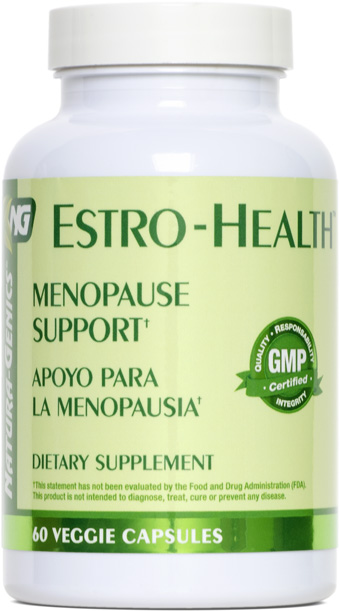
Estro-Health™ is a combination of herbal extracts and gamma-oryzanol, formulated to provide nutritional support throughout menopause.
Menopause is defined as the cessation of a woman’s monthly menstrual cycle. Women who have not had a menstrual period for a year are considered postmenopausal. Most commonly, menopause takes place when a woman is in her forties or early fifties.
One of the main herbs in this formula is black cohosh. Native Americans valued this herb and used it for many conditions, especially gynecological. Black cohosh contains several compounds, including triterpene glycosides, isoflavones, and many more. As women approach menopause, signals between the ovaries and pituitary gland diminish, slowing down estrogen production and increasing luteinizing hormone (LH) secretions. Hot flashes can result from these hormonal changes. Human trials have demonstrated that black cohosh promotes estrogen activity in the organism and helps reduce LH secretions.
Kelp, the sea vegetable, is a rich source of minerals including iodine, potassium, magnesium, calcium, and iron. Kelp, a natural source of iodine, supports the production of thyroid hormones, which are essential for maintaining normal metabolism in all cells. While iodine is primarily stored in the thyroid gland, it can also accumulate in the breasts, ovaries, and uterus. When iodine levels are depleted, estrogen may occupy the vacant space, potentially leading to cysts, lumps, or fibroids.
Dong quai is frequently used in Traditional Chinese Medicine (TCM), and it is sometimes referred to as the female ginseng. It is used to promote the reduction of symptoms associated with menopause. Traditionally, dong quai is believed to have a balancing or “adaptogenic” effect on the female hormonal system.
Another herb used in this product is wild yam. Herbalists have used it for many conditions, including menopause. Wild yams could be converted industrially into cortisone, estrogens, and progesterone.
Ginkgo promotes blood flow to the brain and supports concentration and cognitive function, which is important for menopausal women who may have memory lapses. Ginkgo could promote estrogen levels due to its content of phytoestrogens (vegetable agents with a similar structure to estrogen).
The leaves of damiana are used by indigenous cultures in Central America, particularly Mexico. Damiana extract has been shown in laboratory studies to weakly bind to progesterone receptors. Therefore, damiana may be a potentially beneficial herb for supporting certain aspects of female health.
Squaw vine, although most commonly used for pregnancy and childbirth, is also an effective uterine tonic. It helps promote uterus and ovarian health.
Eleuthero is considered a normalizer, promoting reduced stress and supporting increased energy. It is traditionally used to help relieve stress and fatigue.
Clinical research has suggested that gamma oryzanol has been shown to promote the reduction of menopausal symptoms, including hot flashes.
Red raspberry leaves are known as “the women’s tonic”. They have been traditionally used by herbalists to support female health throughout all stages of life, including pregnancy and the transition from pre- to post-menopause.
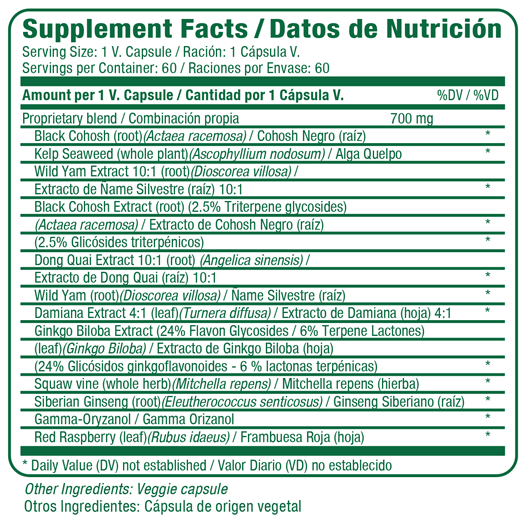
Supplement Facts
Recommendations
Where to buy

