
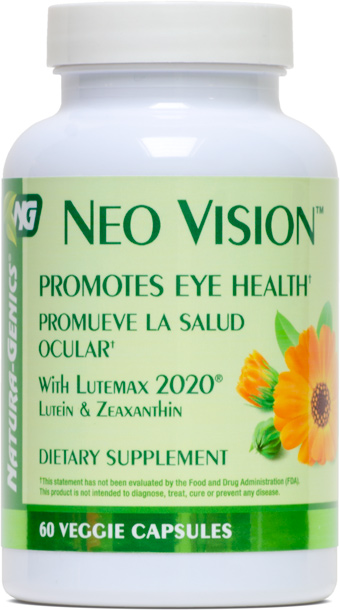
Neo Vision™
60 Veggie Capsules
Research suggests that by 2030, 40 percent of the world’s population will be nearsighted, up 28 percent from 2010. The number of people with high myopia (severe short-sightedness) is projected to almost double during that time, affecting 516 million people.
Eyesight gradually changes with age or the environment. Other factors that affect vision include smoking (smokers are three times more likely to develop age-related macular degeneration (AMD)), sunbathing (UV rays can cause cataracts), stress, and prolonged use of phones and computers (can cause dry eyes and blurred vision).
According to the National Eye Institute, a branch of the National Institutes of Health, because the youngest baby boomers will reach the age of 65 by 2029, visual impairment and blindness are expected to increase to more than 8 million by 2050. Another 16.4 million Americans are expected to have difficulty seeing due to correctable refractive errors such as myopia (nearsightedness) or hyperopia (farsightedness), which can be improved with glasses, contacts, or surgery.
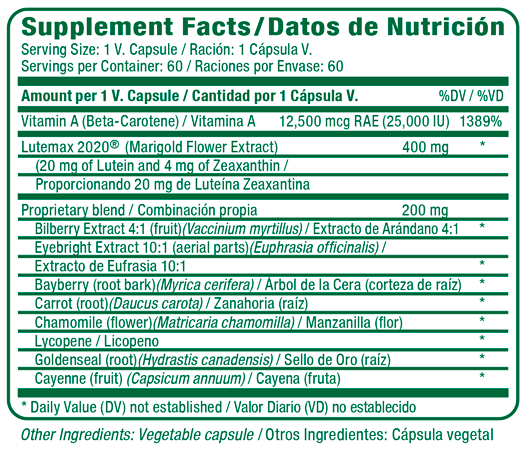
Neo Vision™ is a combination of Lutemax® 2020 and eight (8) additional, important ingredients for vision and eye health.
Ingredients
Lutemax® 2020 is a naturally-derived marigold extract. It provides all three macular carotenoids: lutein, and enhanced levels of both zeaxanthin isomers at the same 5:1 ratio as found naturally in diets. This unique combination of lutein with zeaxanthin isomers makes Lutemax® 2020 a convenient, cost-effective agent for boosting the benefits of eye health supplementation.
Dried bilberry berries and leaves have been recommended for a wide variety of conditions. Modern research on bilberries was partly based on their use by British air force pilots during World War II, who noticed that their night vision improved after eating bilberry jam before night bombing raids. Anthocyanosides, the flavonoid complex in bilberries, accelerate the regeneration of rhodopsin, the purple pigment that is used by the rods in the eye for night vision.
Many herbalists consider eyebright to be an effective herb for eye inflammation, including conjunctivitis and styes. It has also been used for eye fatigue and other vision disturbances. The exact chemical constituents of the herb have not yet been recorded, but it is known to contain a peculiar tannin, called Euphrasia-Tannin acid.
The root and stem bark contain the medicinally active components of bayberry. Traditionally, in European and American herbalism, bayberry was used for a wide range of conditions, including eye concerns. The alkaloid berberine is the active component of this herb. Berberine and its related constituents (such as oxyacanthine) promote antibacterial activity, inhibiting bacteria from attaching to human cells.
Vitamin A is an essential vitamin for good vision and overall eye health. It is a component of the protein rhodopsin, which allows the eyes to see in low-light conditions. According to the American Academy of Ophthalmology, a deficiency can cause night blindness. Vitamin A also supports the cornea function, which is the protective outer layer of the eye. A person who is deficient in vitamin A may find that their eyes produce little moisture to stay lubricated.
The vitamins found in carrots can promote overall eye health. Carrots contain beta-carotene, a substance that the organism converts to vitamin A, an important nutrient for eye health. Vitamin A should always be taken in case of cataracts and macular degeneration, the world’s leading cause of blindness. In addition to beta-carotene, carrots also contain lutein, an important antioxidant. Foods rich in lutein have been found to increase pigment density in the macula. The higher the pigment density in the macula, the more protected the retina is, therefore the lower the risk of macular degeneration.
Chamomile is one of the most popular plants in the preparation of teas for medicinal purposes. Its use is widespread in Latin America for several different applications. In Germany, it is the most consumed therapeutic plant, accounting for almost a quarter of all botanical sources used.
Lycopene, found primarily in tomatoes, is a member of the carotenoid family, which includes beta-carotene and other compounds found naturally in food. It has potent antioxidant capabilities.
Native Americans traditionally used goldenseal to help with respiratory, digestive, and urinary tract mucous membrane complications. It was also commonly used for skin and eye conditions.
Frequently used by herbalists, cayenne has several applications and is considered a potent circulatory tonic. It is a good source of vitamin A and other eye health nutrients.
Supplement Facts
Recommendations
Where to Buy


