
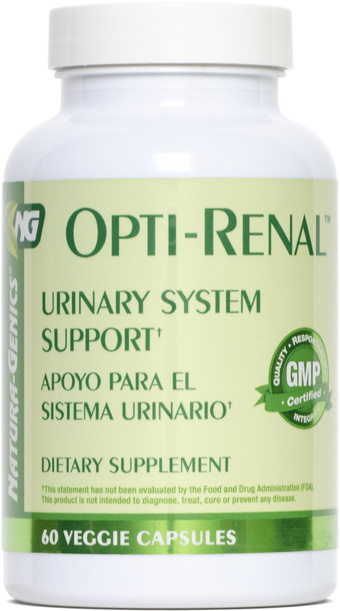
Opti-Renal™
60 Veggie Capsules
The kidneys are two bean-shaped organs, each about the size of a fist. They are located below the rib cage, one on each side of the spine. Kidneys in good condition filter about half a cup of blood every minute, removing toxins and extra water to make urine. Urine flows from the kidneys to the bladder through the ureters (two thin tubes of muscle), one on each side of the bladder, where urine is stored.
Another function of the kidneys is to remove acid produced by cells, and maintain the correct balance of water, salts, vitamins, and minerals such as sodium, calcium, phosphorus, and potassium in the blood. Without this balance, nerves, muscles, and other tissues in the body may not work properly. Additionally, the kidneys produce hormones that help maintain normal blood pressure, manufacture red blood cells, and keep bones strong, among many other functions.
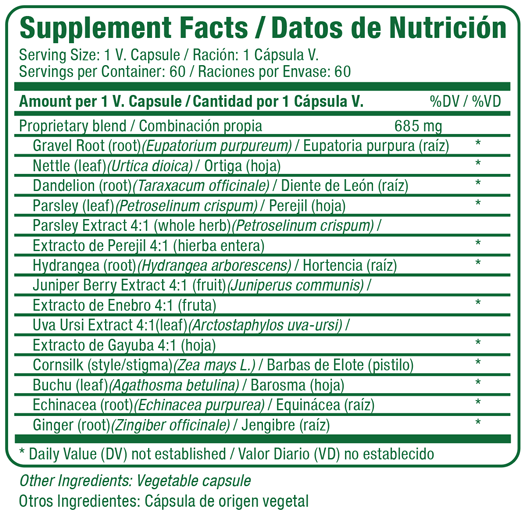
This supplement is a combination of twelve quality ingredients formulated to support the urinary system.
Ingredients
Indigenous to North America, gravel root, also known as queen of meadow, is used as a therapeutic agent for the urinary genital areas, affecting the kidneys, bladder, prostate gland, and uterus. Gravel root relaxes moderately, stimulates, and tones the pelvic viscera and mucous membranes. This herb works well in combination with other herbs. It is also considered a powerful solvent of stony deposits in the kidneys. Gravel root is considered one of the most beneficial herbs for kidney and urinary problems.
Nettle is a therapeutic plant mostly found in temperate regions of the world. It is rich in chlorophyll and minerals such as iron, zinc, copper, magnesium, silicon, cobalt, and calcium. This plant is also rich in vitamins, including A, C, E, and K. It may promote anti-inflammatory activity by helping curb cytokine activity, a key component of inflammation. Nettle also promotes the removal of excess liquids, acting as a natural diuretic.
Dandelion is commonly used as food. The leaves are used in salads and teas, while the roots are used as a coffee substitute. Dandelion leaves and roots have been used for thousands of years to help with several conditions of the liver, gallbladder, and kidneys. Dandelion has been historically used for water retention.
Based on Germany’s Commission E, parsley leaf and root promote the relief of irritation in the urinary tract. It can also be used for kidney stones. Although there is no clear evidence of its activity, parsley contains constituents such as apiol and myristicin, compounds that have diuretic effects, increasing urine flow.
Widely used by the Cherokee Indians and later by European settlers, hydrangea root was used for various renal conditions. Hydrangea is known to promote the removal of uric acid accumulation from the organism, cleanse the kidneys, and soften deposits.
Juniper, an evergreen tree, grows around the world but is mostly found in the plains of Europe. The berries are used medicinally for many conditions, including urinary tract complications, and are currently approved by the German Commission E. According to some sources, juniper berries increase urine volume without depleting electrolytes such as potassium.
Uva ursi leaves are considered medicinal and have been used by numerous Indigenous peoples of northern latitudes. The glycoside arbutin is the main active constituent in uva ursi and comprises 10% of the plant by weight. Hydroquinone, derived from arbutin and methylarbutin, is considered a potent anti-bacterial agent, and it is believed to be responsible for uva ursi’s therapeutic effect on the urinary system.
Cornsilk is an herb used traditionally by Chinese and Native American herbalists. It is currently used in many parts of the world, such as Turkey, France, the United States, and many countries in Latin America. Its potential antioxidant effects and therapeutic applications as a diuretic agent have been reported in several journals. In general, cornsilk is used for urinary conditions.
Originally from South Africa, buchu is used in herbal medicine for urinary conditions. The leaves of buchu contain 1.0 – 3.5% volatile oils as well as flavonoids. The therapeutic actions on the urinary tract are thought to be due to the volatile oils.
Echinacea has been added to this supplement to promote immune function, such as increased interferon activity, which protects cells against viral attacks.
Studies have confirmed that ginger promotes kidney protection and reduces the risk of damage and intoxication.
Supplement Facts
Recommendations
Where to Buy


