
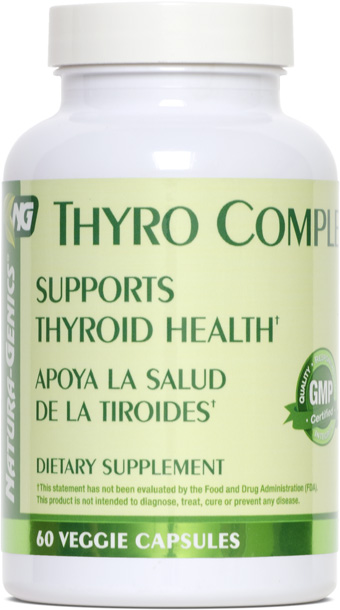
Thyro Complex™
60 Veggie Capsules
Hypothyroidism is a common condition in which the thyroid gland fails to function properly, resulting in reduced levels of thyroid hormones in the body. Thyroid function is based upon the production of T3 (triiodothyronine) and T4 (thyroxine).
There are many causes of hypothyroidism. One common cause is Hashimoto’s thyroiditis, an autoimmune disease that affects the thyroid gland. Another frequent cause is treatment for hyperthyroidism (an overactive thyroid), such as surgery or radiation therapy involving the thyroid gland. Extreme iodine deficiency, which is hardly seen in the United States, is another possible cause. Failure of the pituitary gland or hypothalamus to stimulate the thyroid gland properly can cause a condition known as secondary hypothyroidism.
Some people who have goiter (enlargement of the thyroid gland) also have hypothyroidism. Goiter can be caused by an iodine deficiency, by eating foods that contain goitrogens (found in a wide variety of cruciferous vegetables, fruits, starchy plants, and soy-based products), or by disorders that interfere with thyroid hormone production. In many cases, the exact cause of goiter cannot be determined. While alternative therapies may help to some extent, thyroid hormone replacement is necessary for most people with hypothyroidism, and medical supervision will be needed.
Thyro Complex™ is a combination of L-tyrosine, minerals, and herbal extracts formulated to support thyroid health.
Ingredients
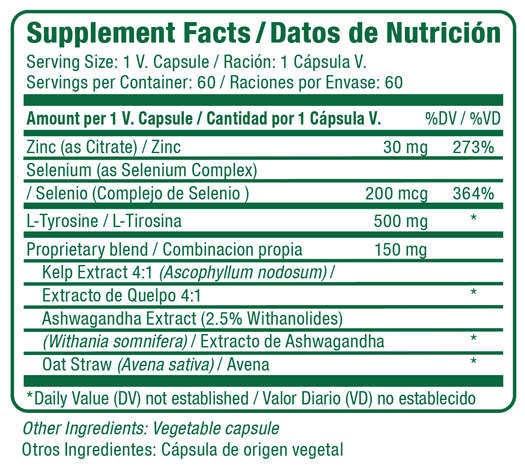
L-tyrosine supplementation is commonly used to support thyroid function. Thyroxin (T4) is naturally produced from the iodination of tyrosine, a non-essential amino acid obtained from dietary sources, and the conversion of phenylalanine. Due to its role in thyroxin (T4) production, tyrosine availability could theoretically affect thyroid function. Improvements in alertness and psychomotor function have been noticed with tyrosine intake, functions that may be lacking in people with hypothyroidism. These effects of tyrosine may result from its role in the production of dopamine, norepinephrine, and melatonin.
Zinc also plays a role in the conversion of the thyroid hormone T4 to T3. According to a study published in the Journal of Endocrinology and Metabolism, zinc significantly improves T3 levels. Zinc appears to be beneficial in improving thyroid function and hormone levels.
Adequate levels of selenium are also required for proper thyroid function. Selenium facilitates the conversion of T4 to the active T3. By improving selenium deficiency, thyroid function may be restored. There is some evidence that selenium intake does reduce thyroid peroxidase antibody (TPO) levels in people with autoimmune thyroiditis.
Rich in iodine, kelp is a popular compound in the dietary supplement industry. Iodine plays an important role in the body and is an essential trace element, supporting thyroid gland function, thus influencing many important processes. Too little or a lack of iodine can trigger the development of hypothyroidism, negatively influencing hormone production, resulting in fatigue or slower metabolism. Kelp algae are natural suppliers of organic iodine, a popular product in naturopathy.
Scientific studies have found ashwagandha beneficial for adrenal stress, fatigue, depression, and anxiety. This herb also helps support the immune system while working as an antioxidant. It has been shown in animal studies to improve T4 and T3 levels. In a human study with individuals with bipolar disorder, ashwagandha improved TSH (Thyroid-Stimulating Hormone), T4, and T3 levels.
Oat straw is a useful herb rich in vitamins A, C, E, K, and B-Complex. It also contains iron, calcium, magnesium, silica, and zinc. Oat straw is used for several nervous system conditions and could also be beneficial in supporting the endocrine system.
Supplement Facts
Recommendations
Where to Buy


